
Perceptual Closing and the Limits of Knowing
Dr Steve Suckling – Centre for Artificial Intelligence Interactions (CAII)
Certainty suggests that nothing else is to be seen. Certainty limits attention. If I am certain I am safe while walking in a North American forest, then a rustling among the trees is nothing worth paying attention to. This research explores how such certainty shapes perception and how excessive confidence in our existing frameworks can generate what are called Outside Context Problems (OCPs)—events or situations that fall beyond the boundaries of what individuals, organizations, or cultures are prepared to recognize.
Drawing on philosophy, neuroscience, psychology, mythology, and organizational studies, the current research develops a multidisciplinary account of how human beings narrow their attention around familiar interpretations of reality. This process, described as perceptual closing, allows people to manipulate and control aspects of the world by isolating them from their wider context. While this narrowing has produced enormous scientific and technological success, it also carries risks: when attention becomes fixed on a single mode of understanding, alternative perspectives are excluded, leaving individuals and institutions unable to respond effectively to novelty, uncertainty, or disruption.
Our current research contrasts perceptual closing with perceptual opening, the capacity to step outside a single perspective and remain attentive to what else might be occurring. Through examples ranging from addiction and social media algorithms to mythological narratives and organizational decision-making, the work illustrates how modern societies frequently manufacture their own OCPs by reducing complex realities to simplified models or metrics.
Our research explores how generative AI might either exacerbate or mitigate these tendencies. Experimental interactions with large language models suggest that AI systems designed to encourage multiple perspectives—rather than provide singular authoritative answers—may help cultivate the perceptual openness required to engage creatively with uncertainty. Ultimately, the study argues that thriving in a complex world depends less on eliminating uncertainty than on developing a relationship with it.

About Dr Steve Suckling
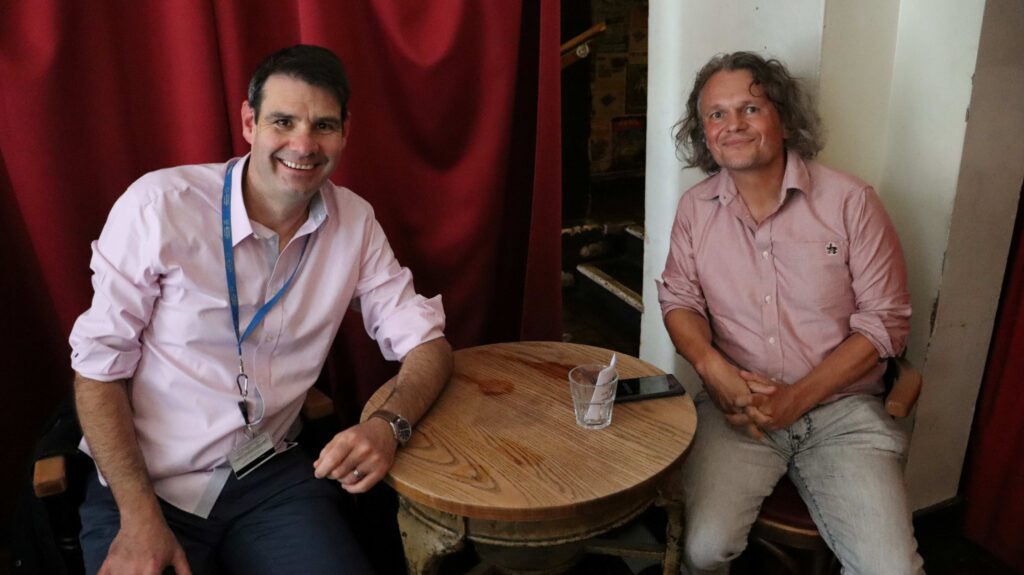
Dr Steve Suckling was the guest speaker at our inaugural HASTE research group meeting. He is an experienced researcher and research director with a career spanning the USA, Europe, and the UK. He has designed and led multinational projects examining organisational behaviour and cognition across the technology, healthcare, and organisational change sectors. In his current work, he draws on his background in philosophy to explore the limits and possibilities of human–AI interaction. He is a founder of the Centre for Artificial Intelligence Interactions (CAII) and is funding collaborative research with HASTE.