
Common ground: history and psychology collaboration in stress research
By Dr Michael Reeve, Lecturer in Modern British History, The Open University.
https://profiles.open.ac.uk/m-j-reeve
Historians have long had an interest in psychology. Janet Oppenheim, Mark Jackson and Mathew Thomson, among others, have produced influential books that have charted the development of the psychological discipline, and conceptions of various mental health conditions, in Britain, across Europe and elsewhere. Others have underlined the key interconnections between history and psychology (for example, Cristian Tileagă and Jovan Byford). Those specialising in the history of emotions, particularly Rob Boddice, have traced the field’s engagement with psychology and neuroscience, as a means to understand the intersection of the body and mind with the social and cultural worlds within which they are situated, and within which emotional responses occur. Interestingly, some psychologists have criticised the tendency of psychological research to remain divorced from ‘cultural and historical factors’, given a prevalent experimental method that sees the mind as discrete from the world around it. The answer, as Brady Wagoner and Ignacio Brescó de Luna suggest, is to explore the uses of history to create a ‘culturally inclusive psychology’. I would argue, echoing the work of historians like Boddice, that this works both ways.
Such scholars combine an interest in understanding past societies with the intellectual and institutional development of psychology – a field that was still in its infancy in the early twentieth century. In a broader sense, disciplinary insights from the social sciences, such as sociology, anthropology and psychology, are often appealing to historians, given our concern with understanding how (and why) people lived, loved, ate, drank, dressed, fought and died (among many other things!) in the past. In short, what made historical actors tick? What was life like for historical actors in all manner of settings, including stressful ones?
Though historians can only ever piece together ‘reconstructions’ of past societies and people, there are certainly affinities with disciplines like psychology. As historian Inbar Graiver wrote recently, both history and psychology share a ‘primary concern with the human condition’. For Graiver, the potential in this shared concern has been squandered due to a lack of consistent dialogue between the disciplines. Indeed, as I’ve already mentioned, while there has been a lively historical subfield concerned with the rise of psychology as a discipline for some time – as well as historical works focused on mental health and specific psychological conditions (including studies of ‘madness’, ‘shell shock’, anxiety and stress) – it is probably fair to say that psychology has tended to focus on the contemporary world, seeking to generate theories and practices for understanding human behaviour in general, without recourse to historical precedent. By contrast, historians may only ever be able to make partial conclusions based on the material they assess (by its nature, often incomplete), and do not necessarily make any claims to general lessons or generalisable experiences across time, geography, cultural boundaries, and so on. But the point of Graiver’s article was to call for closer collaboration between psychologists and historians, to finally make the most of this common ground. This is a call I certainly agree with, and there is much potential.
Histories of stress and ‘nerves’
As a social and cultural historian of modern Britain, one of my central concerns is with the way people lived in the past, particularly how communities (and the individuals, subgroups and constituencies which comprised them) responded to dramatic environmental changes. In other words, how they endured and sought to inculcate resilient attitudes and strategies. My particular focus is war, and the specific ‘war environments’ thrown up by conflicts such as the First and Second World Wars – both ‘total wars’, in that states mobilised entire societies, including civilians, to make them happen. These were environments, rural, urban and industrialised, that were transformed by bombing, the movement and provisioning of troops, and the construction of defensive infrastructure (bomb shelters, anti-aircraft gun emplacements, barrage balloons, and so on). They also induced changes in sensory experience – strange, often anxiety-inducing noises caused by the sounds of aircraft, explosions, air raid warning sirens, and the cries of stricken citizens.
These phenomena had psychological consequences for wartime actors, both combatants and civilians. Most famously, the term ‘shell shock’, a war-specific adaptation of ‘neurasthenia’ – a condition that had been associated with the perceived tensions and stresses of modern life since the early nineteenth century – became the centre of expert and public debate about the damaging effects of warfare on people. During the nineteenth century, modernity had been associated with increasing speed and complexity, particularly with the advent of the telegraph, railways and motorised transport. Distances appeared to be shrinking, the pace of life increasing, and it was assumed that people would suffer from stress and ‘nerves’ as a result. Indeed, the language of nerves had at its heart an attempt to make sense of psychological injury, albeit through a ‘physical or bodily anchor’, in historian Jill Matus’s words. The nerves, in this discourse, were a somatic conduit for psychoactive substances seen to aid the user. As such, ‘nerve energy’ was finite and could be depleted by overwork and undue stress – but it could be replenished with the consumption of particular substances.
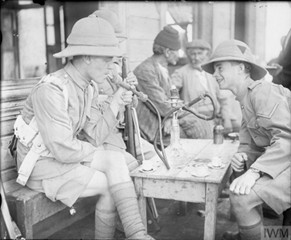
Patent medicines and self-medication with alcohol and tobacco became commonly promoted, even among medical writers – this was true during times of war and peace, though debate was especially pronounced following major conflicts. This included a debate in The Lancet medical journal in the months immediately after the Crimean War (1853-6) – known even then as the ‘Great Tobacco Controversy’ – where the relative benefits of tobacco for the modern subject, and especially the soldier, were regularly stressed by physicians, though not without pushback from other medical experts who feared the longer-term effects of smoking on the nerves and heart. From 1914, with the coming of what appeared to be a truly modern, industrialised war, these same ideas and tendencies maintained their currency. The First World War became known as a ‘War of Nerves’, an epithet that was applied again during the Second World War. For some medics, this was an overriding concern, but it could be treated with an intoxicant that was readily available. As one doctor wrote to the editor of The Times in 1916: ‘The chief danger of war, speaking medically and putting actual wounds on one side, is its terrible effect on nerves. Practically the whole Army is of opinion that in tobacco it possesses a means of counteracting this nervous strain’. This was a way to talk about psychological injury, though it was rooted in the physical body. The assumed usefulness of tobacco for stress relief dies hard. As the American psychologists Cynthia and Ovide Pomerleau put it in 1991: ‘‘The relationship between stress and smoking, and a corresponding link between smoking and anxiety reduction, are so well entrenched in the lore concerning cigarette smoking that they have assumed the status of truisms’.
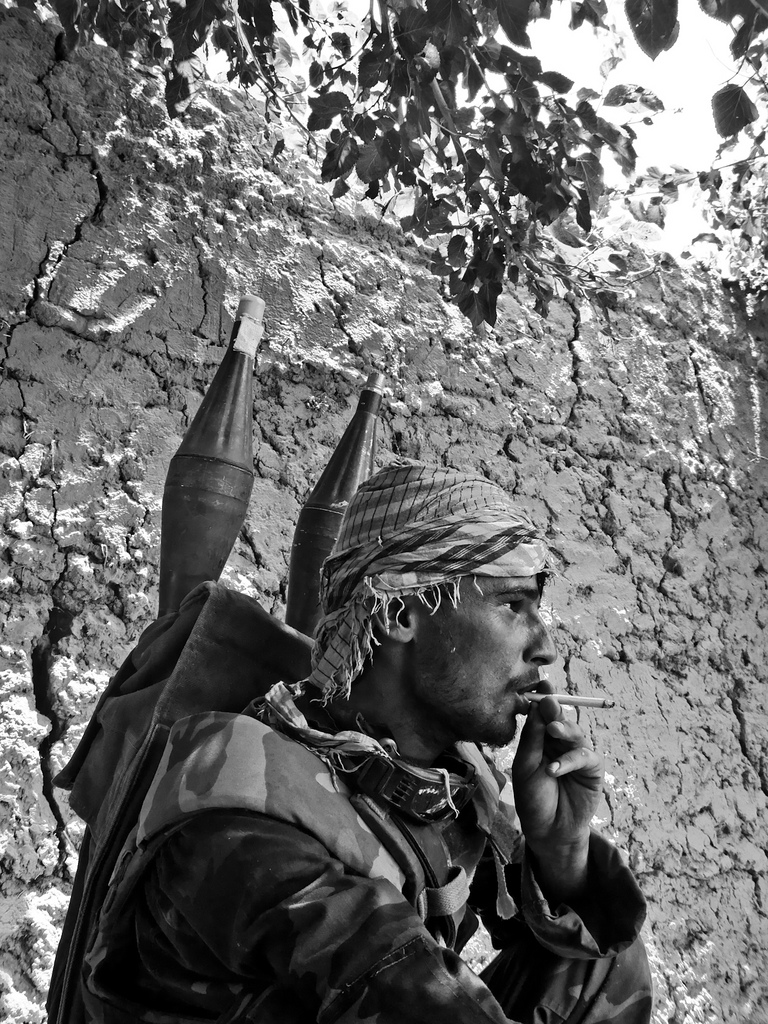
A vernacular language of nerves continues to exist, of course. It remains common to speak of ‘calming the nerves’, and often by engaging with one or more intoxicating substances, whether a cigarette, a post-work pint, or perhaps a CBD gummy. Through my own historical research into wartime smoking, I have found that lay ideas about the stress-relieving value of tobacco (or, more accurately, nicotine) not only deepened and spread during the nineteenth and twentieth centuries, but continue their currency today – perhaps the ever-presence of military conflict, and social and economic turmoil, combine to promote intoxicant use, now as ever. Indeed, recent evidence suggests spikes in smoking incidence during military conflicts and political crises, among service personnel and civilians, as people turn to self-medication to deal with anxiety, stress and psychological injury.
Working together
I have outlined this potted history, and its contemporary resonances, because I think it underlines the longstanding interconnectedness of history and psychology, and it perhaps hints at the ways historical and psychological research overlap and can work together fruitfully. This is particularly the case when it comes to the study of human adaptations to stress and stressful environments which, arguably, are better understood through the lens of historical precedent. My own research area – the intertwined history of tobacco consumption and war – provides one such case study, given the longstanding association of stress relief with smoking, which was heightened and, over time, cemented as wars became all-encompassing (with knock-on effects for the treatment, study and understanding of physical and mental health). More widely, there remains much to be said about historical conceptions and perceptions of stress, and its impacts upon the body and mind, particularly in the context of war. As Graiver has written, this is an opportunity for psychologists to appreciate the historical dimensions of their varied field, and for historians to ask new questions of their source material, particularly those related to ongoing contemporary issues (such as mental health, anxiety and stress, intoxicant use, and so on).
Just before the Christmas break, at the close of 2025, I joined psychologist colleagues in the HASTE research group to discuss the affinities between history and psychology, with a particular focus on the use of intoxicants in the past, and historical debates – among physicians, early psychologists and other medical writers and researchers – related to stress and smoking. For me, this workshop provided a fascinating insight into psychological methods, ways of thinking and frames of reference. I think that HASTE colleagues also learned something about how historians think about topics that interest psychologists and how we conduct our research, particularly the approach in social and cultural history to source materials (letters, diaries, newspapers, photographs, paintings, government policy documents, and so on). I hope that this conversation will continue – future discussions could include greater numbers of historians with differing approaches to cognate topics, with a view to conducting collaborative history-psychology research in the future.
Given that we seem to be living through a (social, economic, political, cultural) ‘permacrisis’ (as some commentators have dubbed the current period in the Western world), there is no better time for truly interdisciplinary, collaborative research into areas with contemporary relevance – anxieties about the present and the future will no doubt remain, and deepen, and people will continue to devise everyday, ‘common-sense’ strategies to deal with stress and to endure periods of strife and uncertainty. There are also, of course, the stressors common to specific professions and environments, such as the worlds of the military and sport, among many others. In short, opportunities for further work abound, and we should take them – disciplinary boundaries are only as fixed as we make them (or assume them to be)!
Further reading
Rob Boddice (2024) The History of Emotions. Manchester University Press.
Inbar Graiver (2021) ‘A Historical Perspective on Mental Health: Proposal for a Dialogue Between History and Psychology’, History of Psychology, 24 (1), 1-12.
Mark Jackson (2013) The Age of Stress: Science and the Search for Stability. Oxford University Press.
Jill Kirby (2019) Feeling the Strain: A Cultural History of Stress in Twentieth-Century Britain. Manchester University Press.
Janet Oppenheim (1991) “Shattered Nerves”: Doctors, Patients, and Depression in Victorian England. Oxford University Press.
Michael Reeve (2025) ‘Smoking and Vaping in Historical Perspective’, History & Policy.
Cristian Tileagă and Jovan Byford (2014) ‘Introduction: psychology and history – themes, debates, overlaps and borrowings’, in Tileagă, C. and Byford, J. (eds.) Psychology and History: Interdisciplinary Explorations. Cambridge University Press, 1-12.
Mathew Thomson (2006) Psychological Subjects: Identity, Culture, and Health in Twentieth-Century Britain. Oxford University Press.
Brady Wagoner and Ignacio Brescó de Luna (2018) ‘Culture, history, and psychology: Some historical reflections and research directions’, Culture & Psychology, 24 (3), 294-309.